

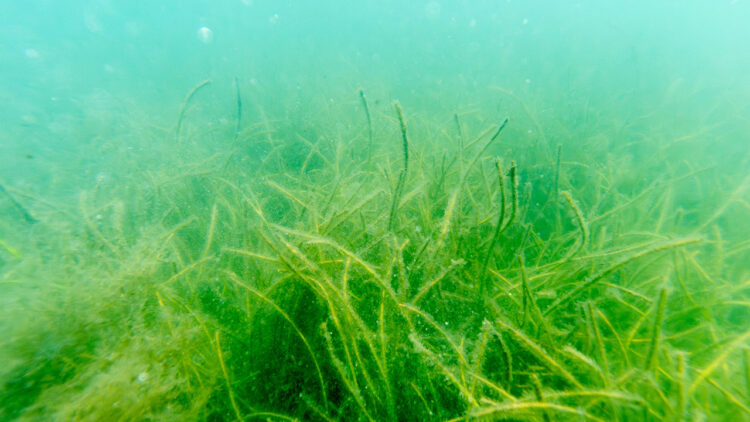
PALM BAY — Seagrass beds in the Indian River Lagoon have grown dramatically in the past two years, with new monitoring data showing both wider coverage and thicker growth across the estuary.
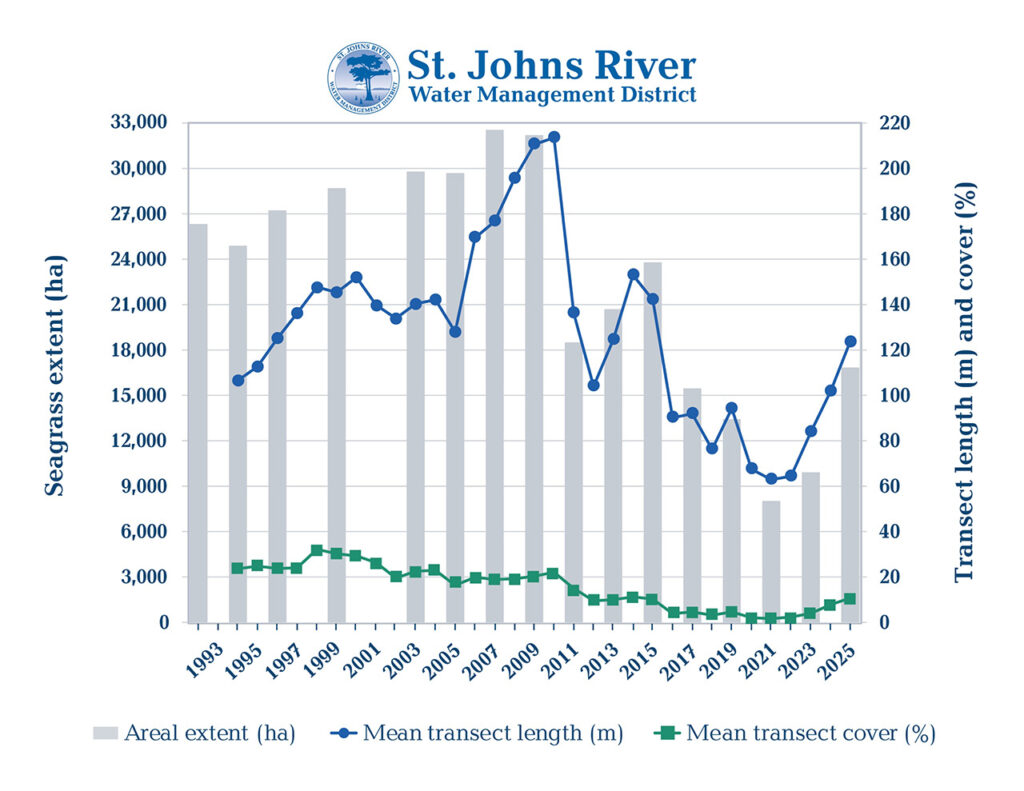
The St. Johns River Water Management District released the 2025 findings Tuesday during its Governing Board meeting. Aerial mapping showed 17,042 hectares of seagrass last year, up from 9,924 hectares in 2023 — an increase of more than 7,000 hectares, or roughly the area of 13,000 football fields.
In-water transect surveys told a similar story. The average length of seagrass along monitoring lines rose from 84 meters in 2023 to 124 meters in 2025. Mean cover along those lines jumped from 3.95 percent to 10.77 percent, signaling that the underwater meadows are not only spreading but also filling in more densely.
“Combining aerial mapping with field transect data gives us a more complete picture of seagrass condition across the lagoon,” said Lorae Simpson, the district’s supervising environmental scientist. “While increases in extent and cover are encouraging, sustained monitoring at multiple scales is critical to guide where and how we focus our management efforts.”
District officials said the gains reflect years of work to fix water-quality problems that have plagued the lagoon for decades. Early in the 1900s, canals built for agriculture and flood control ended up sending excess freshwater and nutrients eastward into the lagoon instead of westward toward the St. Johns River.
To reverse that, the district has finished four canal-diversion projects — C-54, Fellsmere Main, C-1 and the newly completed Crane Creek/M-1 Flow Restoration Project. The projects capture, treat and store water before sending it back toward the St. Johns River, cutting the flow of nutrients into the lagoon.
“These results reflect meaningful progress and years of coordinated effort to improve water quality across the lagoon,” said Mike Register, the district’s executive director. “While we’re encouraged by the trend, continued investment in restoration and science-based management will be critical to sustaining this momentum.”
Brevard County is helping with its own cleanup. Under the Save Our Indian River Lagoon Program, crews are dredging decades-old muck just north of the Eau Gallie Causeway. The material is being piped to a site off U.S. 1 for dewatering and then moved to a district-owned containment area.
Officials stressed that the lagoon still needs continuous restoration, including water-quality projects and coastal wetland work, to keep the recovery going. The district plans to continue its biennial aerial mapping and yearly transect surveys to observe progress and shape future decisions.
