

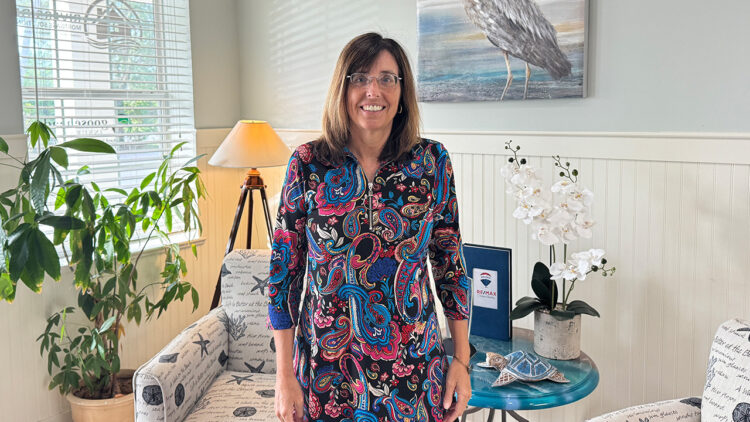
SEBASTIAN — Suzie Piraino of Sebastian gave her left kidney to a stranger in early June, capping a process she started last December after years of thinking it over.
She is a nondirected donor, meaning she offered the organ without naming a recipient. Federal privacy rules keep the two sides from learning each other’s identities unless both choose to write through their transplant teams.
“It was something I had thought about doing for many years,” Piraino told Sebastian Daily. When she contacted the National Kidney Foundation, she said she learned her day-to-day life would not have to change and that she could live on one kidney.
She chose Cleveland Clinic Weston Hospital from a short list of Florida centers with transplant teams after learning the program had performed 111 transplants the previous year.
The workup included testing and meetings with the transplant team. Piraino described the steps as many but “quite seamless and easy.” An advocate contacted her first and stayed with her through evaluation, surgery and recovery. That advocate is still available if she needs help.
Federal law bars payment for an organ. To cover out-of-pocket costs not covered by insurance, Piraino applied to the National Living Donor Assistance Center. The grant paid for gas, meals and a hotel for her and her husband, Joey, when she traveled for a full day of testing, and for Joey while she was in surgery. It also reimbursed two weeks of lost wages.
Medical costs for the evaluation and operation were covered through a mix of foundation support and the recipient’s insurance, she said. The National Kidney Foundation also put her in touch with a living-donor support manager who can arrange a donor mentor and answer questions.
Because the operation is treated as elective, the team asked when she wanted to proceed. After testing was completed, she was added to a national registry and a recipient was identified within a couple of days.
The kidney was flown to North Carolina on a charter flight from an executive airport near Weston and hand-carried to the hospital, where the recipient was already in the operating room.
“The transplant teams are true professionals, and the process was a flawless dance of organization,” Piraino said.
About three weeks ago, she sent a letter through her transplant team. A reply arrived last week, written by the recipient’s wife. The family said the first days were touch-and-go on whether the kidney would take, which explained the delay. By the time of the letter, he was doing much better. Piraino plans to write again.
She is back at work full-time and says she feels like herself. This week she picked up a tennis racket again.
Most recipients keep their own kidneys and receive the donated organ as an extra, she said, so that they can end up with three. The main change for her is to avoid NSAID pain relievers that contain ibuprofen or aspirin, which are processed through the kidneys, and to use acetaminophen instead. Follow-up visits are scheduled at six months, one year, and two years to enable the hospital and the National Kidney Foundation to track donor and recipient outcomes.
Figures shared with her by the foundation, and consistent with national reporting, include:
- More than 90,000 people are on the kidney transplant waiting list at any given time. Data from the Organ Procurement and Transplantation Network listed about 95,500 kidney candidates as of late July.
- About a dozen people die each day waiting for a kidney.
- Roughly 6,500 people donate a kidney each year. On average, 4% to 5% of those donors are nondirected, giving to someone they do not know.
- Most living donors return to normal activity in four to six weeks.
- Donation does not reduce life expectancy. Some studies have found donors live as long as, or slightly longer than, similar people who did not donate, in part because donors are screened as healthy and tend to stay that way.
- Living-donor kidneys generally last longer than kidneys from deceased donors.
- A living-donor team will not approve a candidate if it has concerns about that person’s future health.
Piraino is scheduled to appear on a podcast hosted by Mary Lou and said she plans to share what she learned.
People interested in living donation can start at kidney.org or ask a transplant center about the evaluation process. Help with travel, lodging, and lost wages may be available through the National Living Donor Assistance Center.
