

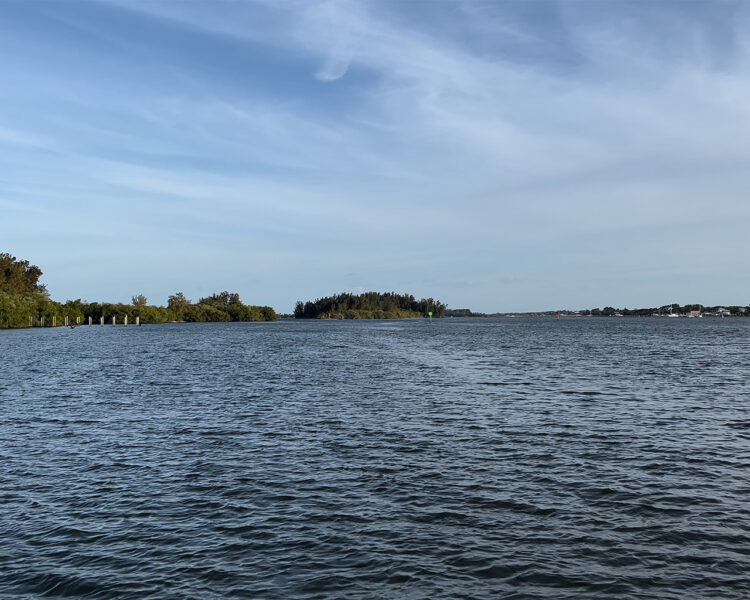
SEBASTIAN — Dissolved oxygen in the Indian River Lagoon at Sebastian recovered to a healthy level early Sunday, rising well above the danger line after sitting at the threshold the day before, the City of Sebastian Natural Resources Board reported.
The board’s Sebastian Area Lagoon Oxygen & Shellfish Watch, based on a 4 a.m. reading from the primary station (IRL-SB-WQ), measured 7.01 milligrams per liter of dissolved oxygen at 91.89% saturation. That was up from 4.01 mg/L the previous morning. No fish kill was reported. The recovery occurred in the pre-dawn hours, when oxygen is typically lowest.
Salinity remained far below normal at 11.22 practical salinity units, against a typical range of about 25–30 for this stretch of the lagoon. The water was still roughly two-thirds fresh, continuing stress on oysters, clams and seagrass, the report said. Carbon dioxide dropped by more than half from the prior day, indicating the heaviest load of decaying organic matter at Sebastian had eased.
Charles Stadelman, chair of the Natural Resources Board, said the report was updated after its initial release once a third data source was confirmed.
“A short update to this morning’s Sebastian Lagoon Oxygen & Shellfish Watch report, sent a few minutes ago,” Stadelman said. “That report said the northern lagoon had no monitoring coverage today, because every IRLON station north of Sebastian is offline and the ORCA Kilroy portal has gone behind a login. Since it went out, we verified a third data source: the St. Johns River Water Management District’s continuous stations are live and public, and at 4:00 AM today they read healthy oxygen across the north — Eau Gallie 7.1 mg/L (salinity 16.6), south of Cocoa 7.5 mg/L, Titusville 6.8 mg/L, Mosquito Lagoon 6.3 mg/L, Banana River 5.6 mg/L — and the District’s Vero station, just south of Sebastian, read oxygen 5.1 mg/L with salinity a very fresh 8.86. The District has no station at Sebastian itself, so Sebastian’s IRLON station remains the only instrument on Sebastian’s water, and the Kilroy inflow readings are still unavailable.”
Link Port, south of Vero Beach, improved to 4.26 mg/L but stayed close to the 4.0 mg/L danger line, with carbon dioxide readings pointing to a heavy load of decaying matter. Fort Pierce held roughly steady at 4.78 mg/L. Both stations also showed low salinity and elevated stain from land runoff.
The board applied its worst-case rule and kept a CAUTION call for the wider Sebastian area. Northern lagoon stations operated by the St. Johns River Water Management District showed healthy oxygen, though salinity was below normal at several sites. The District maintains no station at Sebastian itself.
ORCA Kilroy stations that track canal inflows have been behind a login screen since Saturday afternoon, so no current inflow readings were available. The last accessible data, from Friday night, showed low oxygen in the water entering the lagoon.
The report, compiled by Stadelman with data from IRLON and SJRWMD stations, is a watch and not a closure notice. Anyone harvesting shellfish should first check official status from the Florida Department of Agriculture and Consumer Services and use extra caution after heavy rain and flooding.
