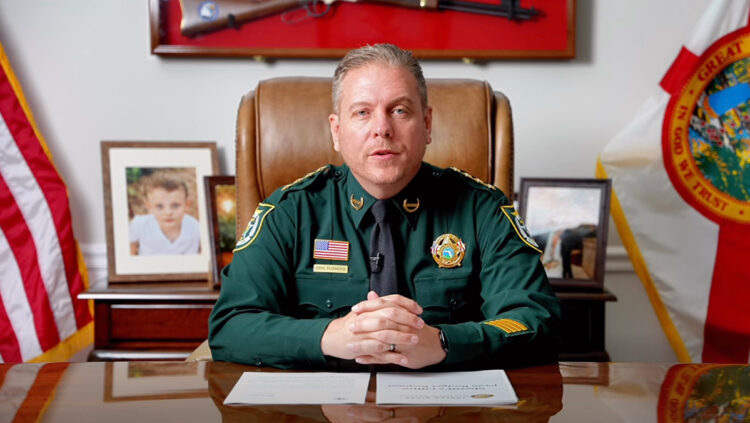
VERO BEACH — Indian River County Sheriff Eric Flowers accused county leaders of embracing a “Defund the Police” mentality in a video posted Wednesday, claiming budget cuts imposed after the fact would jeopardize public safety, from mental health support for deputies to DNA testing for crime victims.
Flowers, in a roughly five-minute address shared on social media to mark the start of the new fiscal year on Oct. 1, said his office entered the 2025-2026 budget period more than $5 million short of what he requested to maintain operations. He submitted a detailed budget proposal on May 1 and posted it online, emphasizing his transparency throughout the process.
“I never thought that in 2025, in the United States of America, in the state of Florida, and especially in Indian River County, that we would ever see the Defund the Police movement come to our hometown,” Flowers said in the video.
The sheriff pointed to a letter he received last week from County Administrator John Titkanich, which he described as arriving “well after the final gavel on the budget was already sounded.” Flowers called the list of mandated cuts a product of decisions made “in the shadows” by an unelected bureaucrat, without public debate or input from citizens.
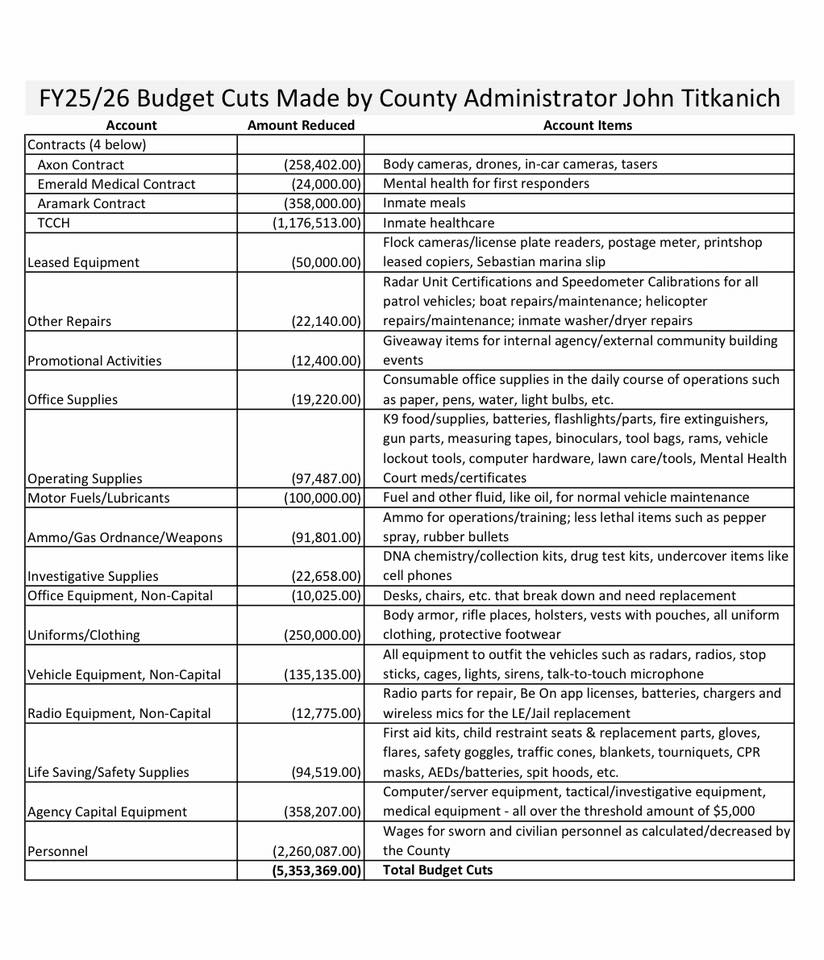
Among the items targeted for reduction, according to Flowers: funding for mental health services for first responders, dog food for police canines, training and ammunition for personnel, safety equipment including AEDs, road flares and traffic cones, supplies for mass casualty events, child car seats distributed to families, and DNA testing kits for criminal investigations.
(Click to enlarge image below)

“Folks, an unelected bureaucrat has told me, the elected sheriff of Indian River County, that mental health for first responders is not important,” Flowers said. “That dog food for our canines is not important. That the safety of our personnel, that their training, that ammunition is not important.”
He added that cuts to casualty care items could prove critical in the event of a mass incident, referencing recent events elsewhere in the country. Flowers also warned victims of crimes that delays in cases due to insufficient DNA supplies could be blamed on the Board of County Commissioners.
In the past, the sheriff criticized the prioritization of consultants over law enforcement needs, noting that while the commission had touted providing his office with more than $20 million over the past five years, it had spent $34 million on consultants in a two-year span and had “nothing to show for.”
Flowers said he plans to post the full document on the sheriff’s office website for public review. He stressed that some budget items relate directly to school safety and child protection, and vowed to pursue all legal avenues to secure adequate funding.
“No, we will not stop here,” he said, addressing Titkanich directly. “We are going to do everything legally possible to ensure that the operations of the Indian River County Sheriff are properly funded and that this money goes where the taxpayers meant for it to go, into public safety.”
In the letter dated last week, which serves as official notice under Florida Statutes §30.49(4), Titkanich outlined the county’s position, stating that the Board of County Commissioners “remains committed to public safety while also balancing those needs with long-term financial sustainability and allocation of limited resources across all Constitutional Offices, support for State agencies serving Indian River County residents, and County operations.”
The document specifies items amended, modified, increased or reduced based on available information, but notes challenges due to the sheriff’s office not budgeting at the subobject code level, as highlighted in a July 10 email from IRCSO Chief Financial Officer Aimee Cooper. Without such details, Titkanich wrote, the board was “constrained in its ability to provide the precise level of specificity required by statute.”
The county reviewed contracts, quotes, invoices and prior year budgets to identify reductions, amending certain line items accordingly. Titkanich acknowledged that Flowers, as sheriff, is “in a better position to determine the priorities and needs of the Indian River County Sheriff’s Office and how best your budget should be adjusted.” He cited §30.49(12), which grants the sheriff authority to transfer funds between categories after board approval.
The dispute follows months of negotiations, with Flowers requesting a $12.2 million increase beyond his previous budget. The commission, after hearings in September, approved a $6.8 million boost on Sept. 17, bringing the sheriff’s total budget to $85 million. To fund this, commissioners cut newly unfilled positions and reduced program funding in other areas.
Flowers expressed disappointment after the vote, saying it showed “law enforcement was not a priority” and could impact staffing and crime response in the growing county.