

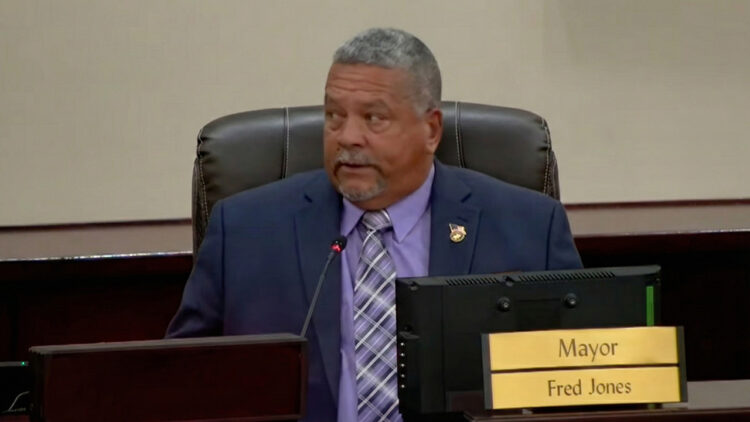
SEBASTIAN — Mayor Fred Jones opened a discussion with the Sebastian City Council on Wednesday to explore ways to control local development, citing public complaints that the city is growing too quickly, even as state law places limits on local governments.
The discussion was in response to property owners wanting to redevelop 58 acres of the Chesser’s Gap commercial site along South Fleming Street into a residential townhouse subdivision in Sebastian.
“I’ve been thinking about this for a while. I’ve heard a lot from the public that people think that we’re growing too fast here, and I feel like we need to slow down, too,” Jones said during the Feb. 11 meeting. He mentioned Senate Bill 180, a state law passed in the aftermath of catastrophic hurricanes like Ian and Nicole, which broadly preempted local governments from regulating land use more stringently after a storm — a category that encompassed most of Florida.
City Attorney Jim Stokes called it a “wrecking ball” to local control, saying it was the Florida Legislature’s response to municipalities across the state that cracked down on expansions and added additional setbacks or construction standards after storms hit. “No municipality or county could make any changes to any land use laws that were deemed more restrictive,” Stokes said. The law prohibits moratoriums on building, forces reactive reviews of developer applications and leaves cities unable to proactively alter zoning or ordinances without property owner requests.
Jones explained that the council retains discretion on individual rezoning bids. “Somebody comes before us and wants to change the zoning that they have now to a different zoning. We do not have to agree to that, right?” he asked. Stokes agreed and said such decisions are handled case by case, often as quasi-judicial matters for small parcels or legislative for larger ones, guided by existing criteria.
Councilman Ed Dodd suggested keeping a balance between private property rights and the community’s vision. “If you stagnate your business to the point where you cannot grow, you will die,” he said. Dodd called for a rewrite of the city’s comprehensive plan and land development code to legally control growth, citing the 2023 annexation of 2,044 acres from the Graves Brothers property as a model. That project was approved unanimously by the council because it included binding agreements.
“We can’t tell a property owner he can’t do what he wants to do with his property as long as it’s within those codes,” Dodd added, but suggested the council ask for written commitments from developers before approvals — such as guarantees for promised affordable or workforce housing.
Jones agreed and said, “there are people that come in and say they’re going to build affordable housing … and it turns out not to be such,” he said. “We have to dive deeper before those things are approved because once they’re approved, it’s a done deal.”
Councilman Chris Nunn praised recent public turnout at the planning and zoning meetings. “I was glad to see people came and got involved,” he said, regardless of agreement on specifics.
Vice Mayor Bob McPartlan noted that the City of Palm Bay’s population 25 years ago was similar to Sebastian’s today. “I moved here in the early 2000s, and I started my career in Palm Bay in 2001. And at that time, Palm Bay was the same as Sebastian. And you go up there now and you wouldn’t recognize it,” he said. But he reminded everyone about the rights of property owners. “If they want to build something on their property that’s within the zoning, it’s the American way.”
Jones said the discussion is a call to action: “I want us to collectively think about this and look at it and say, is there something we can do to help manage the growth that people are seeing here in this town?”
No formal votes were taken, but the council will review any potential code revisions.