

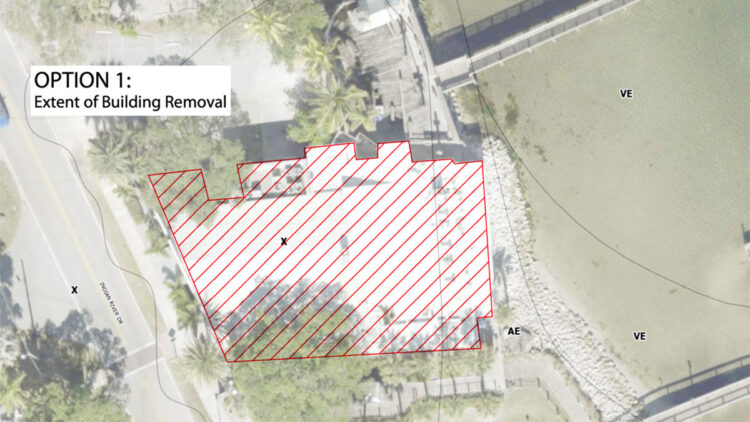
On Wednesday, July 9, 2025, at the Sebastian City Council meeting held at City Hall, the council unanimously voted for Option 1. This plan means tearing down the old Hurricane Harbor building at Fishermen’s Landing, where Crab E Bill’s seafood market used to be, and building a venue for private or public functions in its place that the community can use.
Mayor Bob McPartlan, Vice Mayor Fred Jones, Councilman Chris Nunn, and Councilman Ed Dodd supported the decision because the building has structural problems, past private partnerships that didn’t work out, and they want a venue that better meets residents’ needs.
The next step involves gathering input from the Parks and Recreation Advisory Committee and hosting public workshops to incorporate community feedback on proposed designs.
Mayor McPartlan told Sebastian Daily that the council selected Option 1, prioritizing a community-focused facility that reflects Sebastian’s fishing village heritage while serving as a functional community hub.
Option 1 involves demolishing the existing structure and constructing a new 4,000-square-foot interior space that replicates the original 1927 garage, kitchen/bar, and landing adjacent to the eastern dining area. The design will preserve historical architectural features while complying with current Florida Building Codes.
In the past, the City of Sebastian hired independent engineers to inspect the building, and they identified numerous concerns. The structure, pieced together over the past 100 years, was never brought up to code. The engineers found termite damage and mold, deeming the building unsafe.
The project is expected to cost $2.5 million. This includes $2 million for building the structure and $500,000 for things like electrical wiring, plumbing, heating and cooling systems, and fire safety equipment. The city is working to secure grants to cover the costs, and they plan to start construction next year.
Councilman Ed Dodd started a discussion about the challenges of fixing up the old building. He’s worried about hidden problems, saying, “I have some concerns about trying to save that original building. What happens when we get into it and see what we have to do with all the termite damage and other structural damage?”
Dodd pointed out that unexpected problems could make the project more expensive. He mentioned the building’s past issues, like termite damage and poor roof repairs, which have made the building worse over time.
He suggested turning it into a community venue, instead of a full restaurant or fish market. He stressed that the city should ask the public what they want the building to be used for and avoid repeating past mistakes, like the failed seafood market partnership.
Vice Mayor Fred Jones supported demolition, citing financial prudence. After inspecting the building, he warned, “If we try to save just the old garage part of that, we don’t know what we’re getting into when that roof comes off.” He argued that rebuilding entirely would be more cost-effective than attempting to stabilize the compromised structure.
Councilman Chris Nunn agreed, focusing on being careful with money and avoiding risks that could cost taxpayers. He pictured a venue with a kitchen for catering and a museum to qualify for grants, saying, “I think it would be amazing.”
He believes this center would be a fantastic addition to Sebastian’s riverfront, serving as a key spot for residents. Nunn also supported avoiding deals with private businesses, pointing out that past lease agreements with tenants put the city at a disadvantage.
Mayor Bob McPartlan likened the building to a “house of cards,” noting that no part was ever built to code. “Anything less than Option 1 is going to cost us way more money down the line,” he said, criticizing past attempts to patch up the structure as putting “more lipstick on a pig.” McPartlan supported the community venue concept, envisioning a space for weddings and large family events.
City Engineer Karen Miller clarified that the only lasting requirements from prior grants were an educational component, such as the Sebastian Fishing Museum, and promotion of the fishing industry, which could be achieved through community events rather than a fish market. This flexibility allowed the council to prioritize a community-focused design.
To get the public involved, Dodd suggested that the Parks and Recreation Committee create clear plans by mid-September 2025, which fits with the deadline to use grant money by September 1, 2026.
City Manager Brian Benton supported this, suggesting a public workshop early in the design process to gather input on features, such as a building size ranging from 3,500 to 4,000 square feet or the inclusion of a second floor.
