

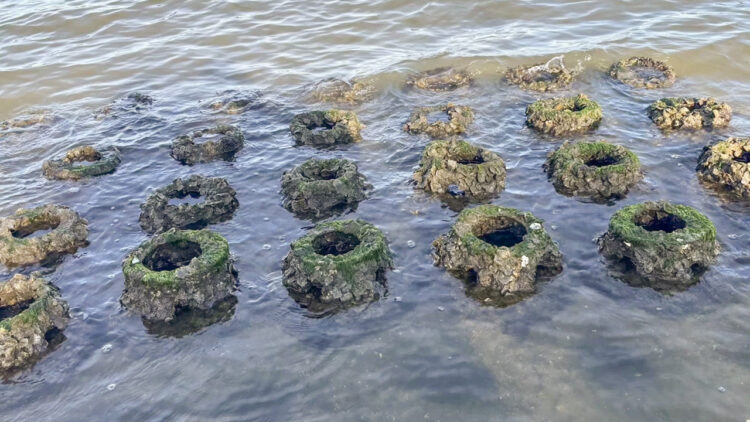
SEBASTIAN — A restoration project at Riverview Park using concrete oyster reef balls to stop shoreline erosion is showing good results in Sebastian. Along the Indian River Lagoon, fresh oyster growth and traces of land building are already visible.
The initiative, led by the Ocean Research and Conservation Association (ORCA), placed modular reef balls offshore in November 2024 as part of a wider campaign to stabilize the eroding banks while strengthening local marine habitats. The balls, designed to dissipate wave energy and provide a surface for oysters to attach and grow, have attracted significant natural oyster recruitment, according to recent monitoring.
Natalie Stephens, a research assistant with ORCA, said they’ve seen evidence of shoreline accretion in as little as six months. She added that they’ve also seen a large amount of oyster recruitment and growth on the reef balls at the one-year mark.
The project tackles persistent erosion issues at the park, exacerbated by wave action, hurricanes and rising sea levels. It covers about 265 linear feet of shoreline and incorporates native vegetation plantings to slow stormwater runoff, replacing traditional turfgrass in a second phase of work.
ORCA selected the site in accordance with Sebastian’s eco-friendly targets, regarding it as a model for “green infrastructure” that improves water quality and provides refuge for fish and other wildlife. Quarterly surveys will continue for at least two more years to track progress, including water clarity, oyster density and changes in the shoreline slope.
Similar living shoreline techniques have been applied by ORCA at nearby locations, including Riverside Park in Vero Beach and sites in Martin County, with plans for expansion as coastal threats intensify.
City officials and volunteers who helped install the structures last year have hailed the early outcomes as a win for the environment as well as the community, which relies on the lagoon for recreation and tourism.
