

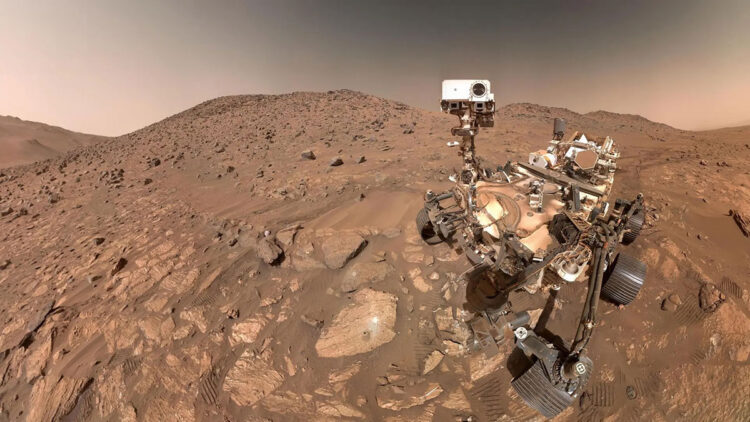
NASA’s Perseverance rover may have uncovered hints of ancient microbial life on Mars, with a rock sample from an old riverbed showing potential signs of biological activity, scientists reported Wednesday.
The sample, dubbed “Sapphire Canyon,” was drilled from a rock called “Cheyava Falls” in Jezero Crater last year. It contains chemical features that could indicate past life, although further study is needed to confirm, according to a paper published in the journal Nature.
A potential biosignature is any substance or structure that might stem from biology but requires further evidence to rule out non-living origins.
“This finding by Perseverance, launched under President Trump in his first term, is the closest we have ever come to discovering life on Mars,” said acting NASA Administrator Sean Duffy in a statement. “The identification of a potential biosignature on the Red Planet is a groundbreaking discovery, and one that will advance our understanding of Mars.”
Duffy added that NASA’s focus on “Gold Standard Science” will persist as the agency aims to send astronauts to the planet.
The rover encountered Cheyava Falls in July 2024 while probing the “Bright Angel” formation along Neretva Vallis, an ancient river valley about a quarter-mile wide that once funneled water into Jezero Crater.
“This finding is the direct result of NASA’s effort to strategically plan, develop, and execute a mission able to deliver exactly this type of science,” said Nicky Fox, associate administrator for NASA’s Science Mission Directorate in Washington.
The sedimentary rocks there include clay and silt, materials that on Earth often preserve microbial fossils. They also hold organic carbon, sulfur, oxidized iron, and phosphorus.
“The combination of chemical compounds we found in the Bright Angel formation could have been a rich source of energy for microbial metabolisms,” said Joel Hurowitz, a Perseverance scientist at Stony Brook University in New York and the paper’s lead author.
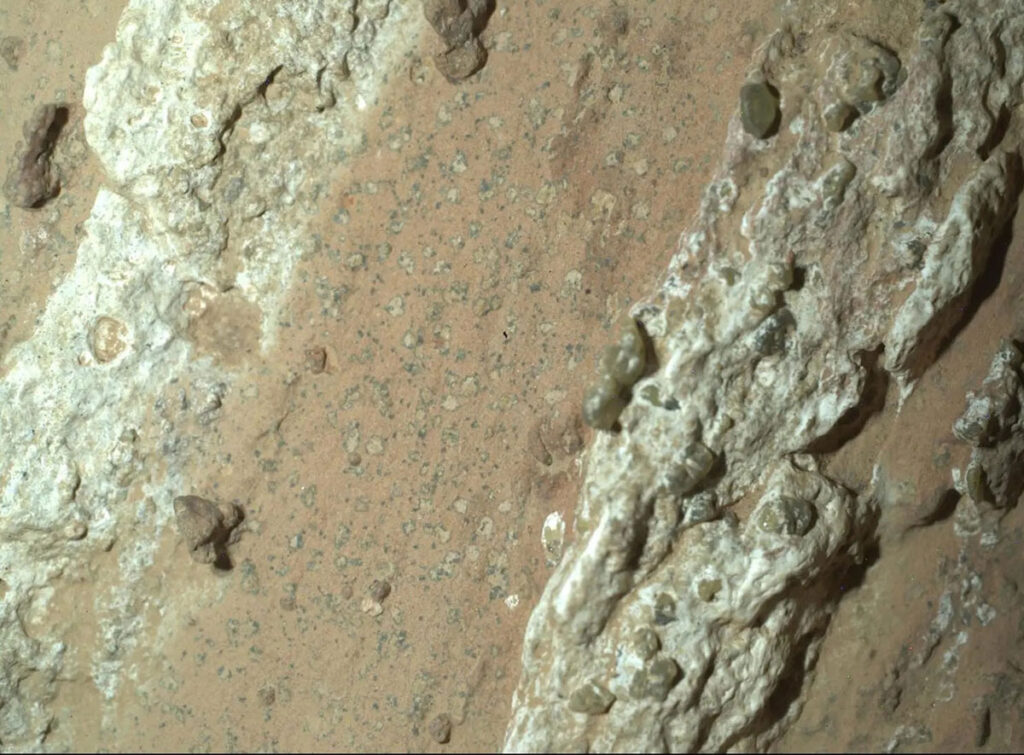
Instruments like PIXL and SHERLOC detected colorful spots on the arrowhead-shaped rock, which measures 3.2 feet by 2 feet. Higher-resolution scans revealed “leopard spots” containing minerals such as vivianite and greigite, often associated with microbial processes on Earth.
These could form through electron-transfer reactions involving organic matter, a potential energy source for life. But they might also arise without biology under certain conditions, which the rocks don’t appear to show.
The discovery stands out because it comes from some of the youngest rocks studied by the mission, suggesting Mars might have been habitable longer than expected.
“Astrobiological claims, particularly those related to the potential discovery of past extraterrestrial life, require extraordinary evidence,” said Katie Stack Morgan, Perseverance’s project scientist at NASA’s Jet Propulsion Laboratory in Southern California.
Scientists use tools like the Confidence of Life Detection scale to gauge such findings.
Sapphire Canyon is one of 27 cores collected since the rover landed in February 2021. The mission, managed by JPL for NASA’s Mars Exploration Program, also tests spacesuit materials and gathers weather data for future human trips.
