

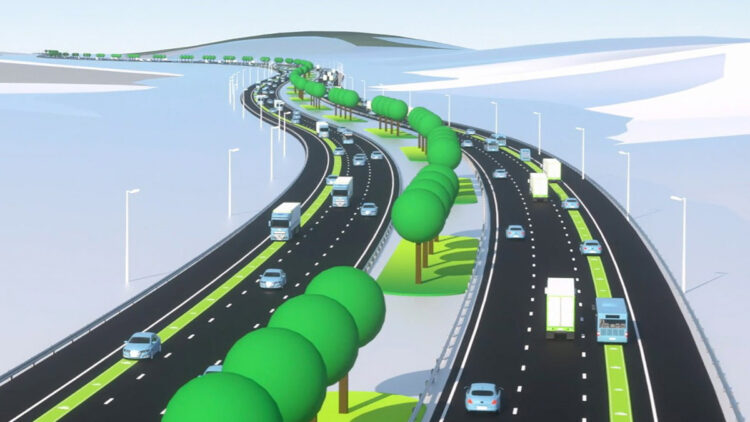
ORLANDO — Florida transportation officials are set to build a pioneering stretch of highway that will wirelessly charge electric vehicles as they cruise along, marking a significant step toward easing range anxiety for drivers in the nation’s third-most populous state.
The Central Florida Expressway Authority announced plans for State Road 516, a nearly five-mile connector linking Lake and Orange counties. The pavement will feature a 0.75-mile portion equipped with inductive charging technology with embedded coils in the pavement that will transfer energy to specially equipped vehicles via electromagnetic fields to recharge batteries without stopping.
Construction on the project, dubbed the ASPIRE Pilot, is slated to begin in 2026 with completion expected by 2029. The initiative partners the expressway authority with Norway-based ENRX, a leader in wireless induction tech, and the ASPIRE Engineering Research Center at Utah State University.
“This is a game-changer that will speed up the energy transition,” said Richard van den Dool, ENRX’s vice president for charging. He added that the system could reduce the need for large, costly batteries in EVs.
The roadway, stretching from U.S. Highway 27 in south Lake County to State Road 429 in west Orange County, aims to alleviate east-west traffic congestion while testing dynamic charging capable of delivering up to 200 kilowatts for trucks and about 50 kilowatts for passenger cars. Over the short electrified footprint, vehicles could gain enough juice to cover an additional mile or more of travel.
Beyond charging, the $233 million project incorporates eco-friendly elements like solar panels generating nearly 1 megawatt of power, a wildlife underpass for animals heading to the nearby Green Swamp, and native landscaping to minimize maintenance. An adjoining multi-use trail will cater to pedestrians and cyclists.
Lake County Commissioner Sean Parks noted the road supports economic growth by connecting job centers and improving regional links. Daily traffic is projected at 21,000 vehicles initially, climbing to 25,000 within five years.
“When you can charge while driving, range anxiety and frequent charging stops will be a thing of the past,” said ENRX CEO Bjørn Eldar Petersen. He added that the setup is maintenance-free and built to last decades, positioning Florida as a national model for sustainable transport.
For now, only cars and trucks fitted with matching receivers can tap into the charging system. But state leaders are betting this test run will open doors to broader use. Backed by federal dollars from the National Science Foundation, the effort fits into a larger drive for powered-up roadways as electric vehicle numbers keep climbing.
Florida joins a handful of states experimenting with in-road charging, but this marks the first public multilane freeway deployment in the U.S., according to ASPIRE’s Michael Masquelier.
