

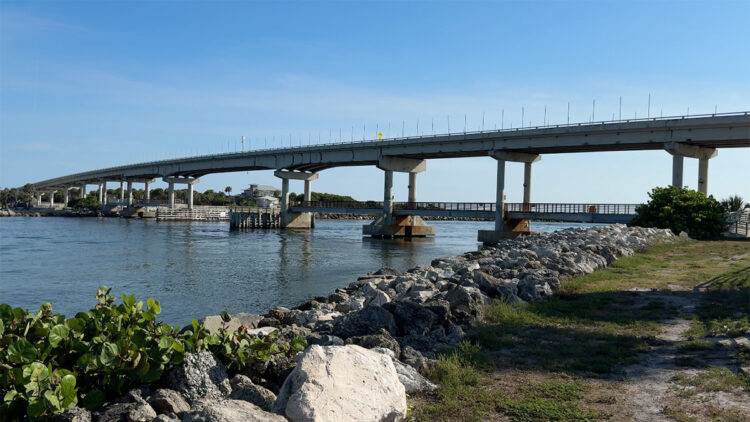
INDIAN RIVER COUNTY — Parts of the old Sebastian Inlet Bridge will live on underwater as artificial reefs, thanks to a plan by Indian River County to repurpose 3,500 tons of demolition debris in a boost for marine life and local fishing.
The county is partnering with the Coastal Conservation Association and the Florida Department of Transportation to haul the concrete and steel chunks offshore, thereby expanding the reefs approximately 10 miles east of the inlet. Construction on the new $111.7 million bridge is set to start early next year, with the old 1960s-era structure slated for demolition in 2028.
County Administrator John Titkanich called the collaborative project a testament to what can be achieved through strong partnerships. He credited FDOT, CCA, and state Rep. Robbie Brackett for helping advance the initiative, which the County Commission approved in August.
The debris will be barged to the Orchid Island Artificial Reef complex, a cluster of eight sites in 65 to 70 feet of water, roughly three miles south of the inlet. The material will enhance five of those reefs, under permits from the U.S. Army Corps of Engineers, allowing up to 12 sites total.
Logan Kennovin, CCA’s assistant director of habitat and environmental restoration, said the idea emerged when he learned of the bridge replacement and reached out to FDOT.
Kennovin expects sessile organisms like algae, barnacles, corals, and sponges to colonize the concrete within a year. Another year after that, the reefs should draw open-water fish such as mackerel, sailfish and baitfish.
The $220,000 project splits costs evenly between the county and CCA, which gets naming rights for the reefs in return. Kylie Yanchula, director of the county’s Natural Resources Department, called it an investment in the health of our coastal ecosystem and our community.
Florida leads the nation in artificial reefs, with about 4,500 along its 1,350-mile coastline, including dozens off Indian River County. These manmade structures — from sunken ships and railroad cars to construction rubble — support biodiversity, protect shorelines and aid coastal economies.
Edie Widder, founder and senior scientist at the Ocean Research & Conservation Association in Vero Beach, praised the effort. She said they have seen firsthand how important it is to provide solid substrate in coastal waters, noting that reefs offer attachment points for marine life and shelter for fish.
Beyond ecology, the reefs are expected to attract sport fishermen and divers, generating revenue for local hotels, gas stations, and shops.
Yanchula said the project will create new marine habitat, support local fisheries, and enhance recreational opportunities for our residents and visitors.
CCA, founded by 14 fishermen in 1977, focuses on protecting fish stocks and marine habitats. The Sebastian Inlet plan aligns with its mission to build reefs that benefit coastal wildlife and economies.
The new bridge, linking Indian River and Brevard counties, is scheduled for completion by 2031. Demolition will generate about twice the debris being reused, with the rest handled separately by FDOT.
